

Analyses
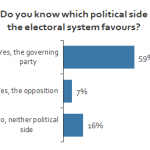
“Not even those who count it understand it.” It is a frequent experience that many Hungarians have this attitude on the electoral system. If a system is impossible to comprehend, the electorate does not see the link between the ballot cast and the composition of the Parliament, which, in the end, undermines trust in the whole democratic system.
The one and a half year-long political campaign, which has been the most expensive one ever in Hungary, was not enough for a valid referendum. The 40% voter turnout shows that the campaign considerably underperformed the governing party’s expectations, the representatives of which had been talking about the importance of the validity of the referendum before the start of the last week of the campaign.
Fidesz, in opposition, convinced more than 3.3 million people to vote in line with their recommendation, which was a “yes” vote at the time. Now, 3.2 …
In populist or, rather, in illiberal systems, after the conquest of independent institutions, referenda and other tools of direct democracy (such as civic disobedience, protests, strikes) become even more important as units of the diminishing set of instruments used to assert people’s interests against those in power. Since 2010, the Hungarian government has been successful at preventing any unwanted referendum to take place. Even more concerning is the fact that with the anti-quota referendum, one of the gravest dangers of illiberal politics seems to be materialising: the leadership’s reaction is …
On November 30, 2015, the Center for EU Enlargement Studies of the Central European University, with the support of the Budapest Büro of the Friedrich Ebert Foundation, has organized an international conference dedicated to the role of elections in young democracies of Central and Eastern Europe. With this international conference, CENS aimed to create an opportunity for critical debate concerning elections in post-communist EU member states by discussing the significance of election results and their far-reaching consequences on EU governance.

DGAP’s “Hungary in the Media, 2010–2014 – Critical Reflections on Coverage in the Press and Media” report received mixed reactions. Two Political Capital staff members were present at two out of the several background conversations organized to collect information for the study. As only a fraction of our findings and provided background materials were used in the final version, we feel compelled to react to the published report, and more specifically to the chapter on the electoral system.
Budapest, June 3, 2015 – Political parties likely spent close to HUF 11 billion on their campaigns in 2014 and 2015 at the parliamentary and municipal elections, as well as on the by-elections held in Veszprém and Tapolca. This was the main finding of the civil campaign monitoring study carried out by Átlátszó, K-Monitor, Political Capital and Transparency International Hungary (TI). State support for political parties’ campaigns came to HUF 3.4 billion, while the civil organizations estimate that their expenses totaled some HUF 7.5 billion. The four participating organizations have …
It is patently clear: the poor are defenseless, and defenseless people are more likely to become the victims of election fraud. In Hungary public works schemes involving hundreds of thousands may increase these odds: while in the short term state-funded programs available for the unemployed and administered by municipalities may offer a slightly better life than welfare, they also create a one-sided dependence between citizens and local politicians.
As part of their joint project, Átlátszó, K-Monitor, Political Capital (PC) and Transparency International Hungary looked at the potential correlation between public employment …
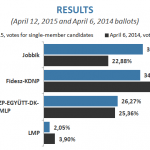
On April 12, the far-right Jobbik candidate won a by-election in the individual constituency of Tapolca. The election took place due to the death of former Fidesz MP Jenő Lasztovicza in early January 2015. The electorate dissatisfied with the performance of the government turns to the political side it considers capable of defeating Fidesz. On February 22, in the Veszprém by-election this meant giving the mandate to the individual candidate supported by left-wing parties, Zoltán Kész, and in Tapolca backing Jobbik candidate, Lajos Rig. With this the governing party’s “central …
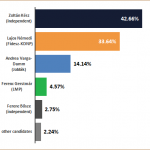
On February 22, in an electoral district in western Hungary, considered as a stronghold for the right, Zoltán Kész, an independent candidate supported by leftist opposition parties, beat his rival representing the ruling party by 9%. With this the Fidesz-KDNP coalition lost its two-thirds majority, and the defeat may have significant political repercussions.
Five Statements About The Municipal Elections:
1. Rejection of politics is indicated by a steady decrease in political participation
2. Fidesz wins by losing
3. Left-wing parties are unable to attract new voters
4. Jobbik consolidated its position in urban centers
5. LMP is the biggest loser of the municipal elections